
QuickFile720
What Is the Repurchase of Corporate Stock Tax and How Much Is It?
- The Repurchase of Corporate Stock Tax is a federal excise tax imposed under Internal Revenue Code § 4501 on certain stock repurchases made by covered corporations and specified affiliates. The tax was established by the Inflation Reduction Act of 2022 and generally applies to stock repurchases occurring after December 31, 2022.
- The excise tax is calculated at 1% of the fair market value (FMV) of stock repurchased during the taxable year by eligible corporations. The tax is reported using Form 720 (Quarterly Federal Excise Tax Return) with Form 7208 (Excise Tax on Repurchase of Corporate Stock) attached to calculate the liability.
The tax generally applies to:
- Covered corporations - generally, domestic corporations whose stock is traded on an established securities market.
- Applicable specified affiliates - certain U.S. entities that acquire stock of an applicable foreign corporation under the rules of IRC §4501(d).
- Covered surrogate foreign corporations and certain related entities - foreign corporations treated as covered surrogate foreign corporations and subject to the stock repurchase excise tax rules.
A repurchase generally includes a redemption of stock under IRC § 317(b) and certain economically similar transactions treated as stock repurchases under IRS regulations.
Who Pays the Repurchase of Corporate Stock Tax?
The tax liability generally applies to the corporation responsible for the stock repurchase transaction. A corporation may be required to file Form 7208 if it repurchases its own stock or if a specified affiliate acquires stock covered under the rules of IRC § 4501.
The filer must calculate the total fair market value of applicable stock repurchases, apply any available exceptions or adjustments, and determine the final excise tax amount reported on Form 720.
Form 7208 is an annual form attached to Form 720. The Form 720 with the attached Form 7208 is generally due for the first full quarter after the close of the corporation’s tax year. The amount calculated on Form 7208 is reported under IRS No. 150 on Form 720.
Common Challenges in Filing the Repurchase of Corporate Stock Tax

1. Managing Multiple Forms and Attachments
Repurchase of Corporate Stock Tax reporting requires both Form 720 and Form 7208, which can make the filing process more complex. Keeping information consistent across multiple forms and attachments is essential to avoid errors.

2. Determining Filing Eligibility
Identifying whether a corporation is subject to the stock repurchase excise tax can be challenging. Taxpayers must determine whether they qualify as a covered corporation, applicable specified affiliate, or another entity covered under IRC §4501.

3. Understanding the Correct Filing Deadline
Unlike regular quarterly Form 720 filings, Form 7208 follows an annual reporting requirement and must be attached to the Form 720 due for the first full quarter after the close of the corporation’s tax year. Tracking the correct deadline based on the tax year-end can prevent late filing issues.

4. Calculating the Taxable Repurchase Amount
Calculating the excise tax requires determining the fair market value of applicable stock repurchases and applying available adjustments or exceptions. Accurate recordkeeping and transaction details are necessary for proper reporting.

5. Maintaining Proper Documentation and Records
Stock repurchase transactions often involve detailed financial information, including transaction dates, stock values, and supporting calculations. Maintaining complete records helps support the amounts reported and ensures compliance with IRS requirements.
Smart Solution for Your Repurchase of corporate stock tax Filings
1. Manage Multiple Forms in One Place
Handle Form 720 and Form 7208 through a single streamlined interface instead of managing separate forms manually. Keep your filing information organized and simplify the submission process.
2. Automatic Tax Calculation
Reduce manual calculation efforts with a guided filing experience that helps calculate the applicable excise tax amount based on the information provided.
3. Simplified Data Entry Process
Enter your repurchase details through an easy-to-follow workflow designed to reduce complexity and help ensure required information is captured accurately.
4. Secure Electronic Filing Experience
Submit your Repurchase of Corporate Stock Tax filing electronically through a secure, IRS-authorized e-filing platform without the need for paper forms or manual submissions.
5. Easy Filing Management and Record Access
Keep your filing details, submitted forms, and important records organized in one place for easier access and future reference.
Repurchase of Corporate Stock Tax Filing:
Manual vs Online Steps
| Manual Filing Steps (Paper Filing) | Online Filing Steps With QuickFile720 |
|---|---|
| 1. Download the latest version of Form 720 and Form 7208 from the official IRS website. | 1. Create your QuickFile720 account and log in securely. |
| 2. Review Form 720 instructions to locate Repurchase Taxes IRS No.150 | 2. Enter your business details including EIN and filing quarter. |
| 3. In Form 720, Enter business details including name, address, EIN, and contact information |
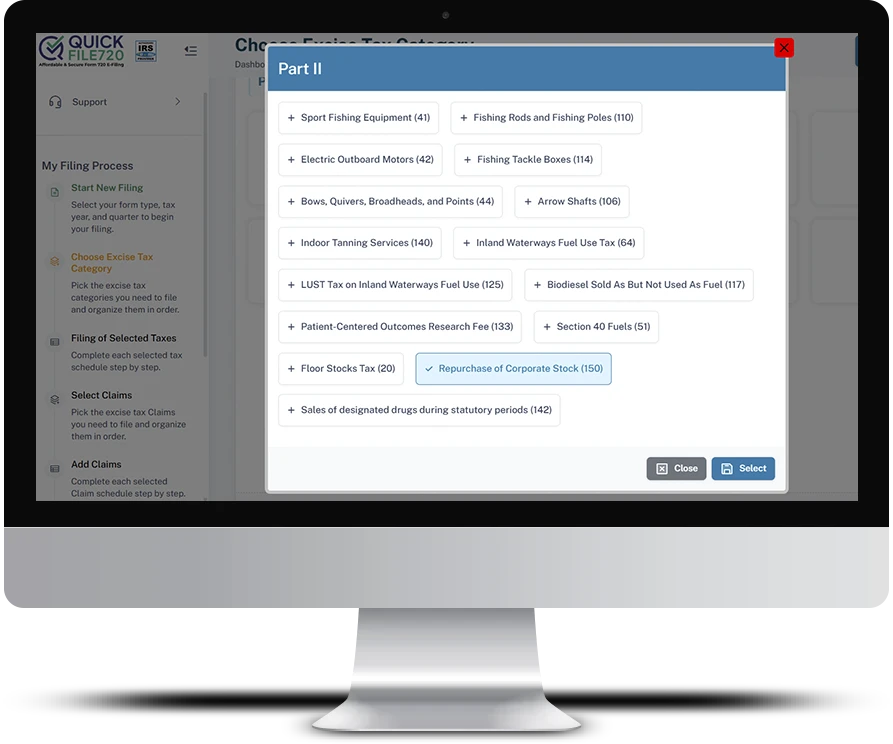
3. Select Repurchase of Corporate Stock Tax
(IRS number
150) under part 2 |
| 4. Enter the correct tax quarter and tax year manually. | 4. Select the tax period. Based on the calendar year or fiscal year your period should be mentioned |
| 5. Enter the Tax amount to be paid under the correct category | Input the relevant details like Stock Transaction Type, Stock Symbol, Stock Symbol Value, Class of Stock etc |
| 6. In Form 7208, Fill the same business details from Form 720 and enter the details required in part 1 which includes type of transactions, number of shares etc. | 5. Your tax amount is automatically calculated based on the input provided and displayed for review. |
| 7. Enter all corporation detail and manually calculate the fair market value (FMV) of repurchased shares and enter the total in line 3 | 6. Submit your return online with secure payment and receive Instant Acknowledgement |
| 8. Read point 4 carefully and proceed further if you are applicable for it. | |
| 9. Once filled all your details in Form 7208 recheck all the values | |
| 10. Attach form 720, Form 7208 and your payment check | |
| 11. Send the entire package to the correct IRS mailing address |
File Repurchase of Corporate Stock Tax Online
File NowForm 720 Due Date
| Quarter | Tax Period Covered | Form 720 Due Date |
|---|---|---|
| Q1 | January 1 – March 31 | April 30 |
| Q2 | April 1 – June 30 | July 31 |
| Q3 | July 1 – September 30 | October 31 |
| Q4 | October 1 – December 31 | January 31 (following year) |
Form 7208 Due Date
The key rule is: Form 7208 is filed annually and attached to the Form 720 due for the first full calendar quarter after the close of the corporation’s or partnership’s tax year.
| Example | Tax Year | Tax Year Ends | First Full Quarter After Year-End | Form 7208 Filed With | Due Date |
|---|---|---|---|---|---|
| Example 1 | Jan. 1, 2026 – Dec. 31, 2026 | Dec. 31, 2026 | Q1 2027 (Jan.–Mar.) |
Q1 2027 Form 720 |
April 30, 2027 |
| Example 2 | July 1, 2025 – June 30, 2026 | June 30, 2026 | Q3 2026 (Jul.–Sep.) |
Q3 2026 Form 720 |
October 31, 2026 |
Form 720 penalties for not filing
Repurchase of
corporate stock tax
| Penalty Type | Description | Penalty Amount |
|---|---|---|
| Late Filing Penalty | If Form 720 is filed after the due date and there is unpaid tax. | 5% of the unpaid tax per month (or part of a month), up to 25% of the total unpaid tax. |
| Late Payment Penalty | If the excise tax due is not paid by the filing deadline. | 0.5% of the unpaid tax per month, up to 25% of the unpaid tax. |
| Interest on Unpaid Taxes | Interest is charged on unpaid taxes and penalties until the balance is fully paid. | Interest accrues from the due date of the return until payment is made. |
| Failure to Deposit Penalty | If required excise tax deposits (such as semimonthly deposits) are not made correctly. | The penalty amount varies depending on how late the deposit is made. |
Testimonials
Simplified Filing Through One Seamless Platform
Managing Form 720 and Form 7208 together was much easier with QuickFile720’s single interface. Everything I needed was available in one place without switching between multiple forms or systems.
Fast Acknowledgment Without the Waiting
QuickFile720 made the filing process smooth and efficient. I received confirmation quickly after submission, which helped me stay updated on my filing status.
Affordable Solution for Corporate Tax Filing
QuickFile720 provided an easy way to complete my Repurchase of Corporate Stock Tax filing without high processing costs. The platform delivered a simple filing experience at an affordable price.
Looking for a simpler way to manage your Repurchase of Corporate Stock Tax filing? See how QuickFile720 streamlines the entire process by bringing Form 720 and Form 7208 together in one easy-to-use platform. Our experts can help you understand the filing workflow, organize required information, and complete your submission efficiently.
Book a Free Demo