
QuickFile720
What Is Ship Passenger Excise Tax?
The Ship Passenger Excise Tax is a federal tax imposed on certain commercial ship voyages, including overnight cruises and gambling cruises.
- IRS Tax Number: 29 (Transportation by Water)
- IRS Tax Section: Internal Revenue Code (IRC) Section 4471
- Tax Rate: $3 per passenger
- Applicable Form: IRS Form 720 (Quarterly Federal Excise Tax Return)
- Taxable Voyages: Commercial ships with sleeping accommodations for at least 17 passengers on voyages lasting more than 24 hours, and certain gambling cruises beyond U.S. territorial waters.
- Filing Frequency: Quarterly
Who Pays Ship Passenger Excise Tax?
The commercial ship operator is responsible for paying the Ship Passenger Excise Tax. This
includes operators of qualifying overnight passenger cruises
and gambling cruises.
Operators must calculate the tax based on the number of taxable passengers and report it
quarterly using IRS Form 720.
Common Challenges in Filing the Ship Passenger Tax

Accurately Counting Taxable Passengers
Keeping track of the correct number of taxable passengers can be challenging, especially when multiple voyages take place. Incorrect passenger counts can lead to errors in tax calculations.

Identifying Taxable Voyages
Not all ship voyages are subject to the Ship Passenger Excise Tax. Understanding which trips qualify under IRS rules is essential to avoid incorrect tax reporting.

Applying the Incorrect IRS Tax Rate
Using outdated or incorrect tax rates can result in inaccurate tax calculations. Ship operators must verify the applicable IRS rate before preparing Form 720 as it can change at any time.

Manual Calculation Errors
Manually calculating taxes for multiple voyages can lead to mistakes. Even small errors in passenger counts or calculations can affect the total tax liability.

Managing Multiple Voyage Records
Tracking taxable passenger details across numerous voyages can be time-consuming. Maintaining accurate records of passenger counts, voyage dates, and taxable trips is essential for proper reporting.
QuickFile720 - Smart Solution for Your Ship Passenger Tax Filings
Filing Ship Passenger Tax doesn't have to be complicated. QuickFile720 makes the process
easier with a simple, secure, and
IRS-authorized e-filing solution that helps you
file Form 720 accurately, save time, and stay compliant with IRS requirements.
Automated Tax Calculations
QuickFile720 automatically calculates your Ship Passenger Tax using the applicable IRS tax rate. This helps reduce manual calculation errors and ensures accurate tax reporting.
Built-In Error Validation
QuickFile720 includes built-in error checks to identify common filing mistakes before submission. This helps improve filing accuracy and reduces the chances of IRS rejections.
Accurate IRS Tax Categorization
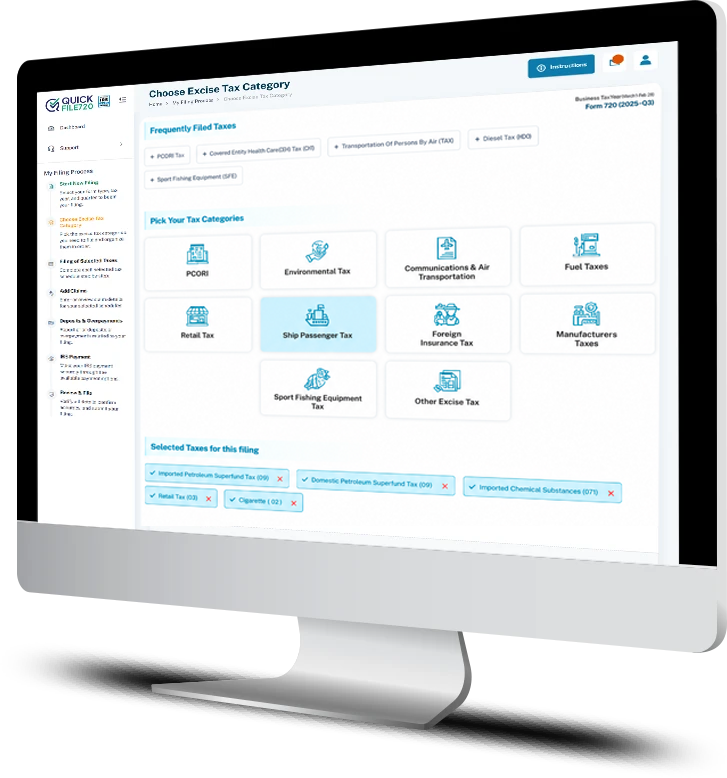
QuickFile720 simplifies tax reporting with clearly categorized IRS tax numbers, including Tax No. 29 for Ship Passenger Tax. This helps you select the correct tax category and avoid confusion when preparing Form 720.
Secure and IRS-Authorized
E-Filing
File your Ship Passenger Tax securely through QuickFile720, an IRS-authorized Form 720 e-filing provider. The platform helps protect your sensitive information while providing a convenient online filing experience.
Easy Access to Filing Records
QuickFile720 keeps your filing records organized and accessible in one place. Easily retrieve previous returns, review filing details, and maintain records for future reference.
Ship Passenger Tax Filing: Manual vs Online Steps

- 1. Download the latest version of Form 720 from the official IRS website.
- 2. Review Form 720 instructions to locate Ship Passenger Taxes - Transportation by water (IRS No.29)
- 3. Enter business details including name, address, EIN, and contact information
- 4. Enter the correct tax quarter and tax year manually.
- 5. Enter the number of persons liable for the tax.
- 6. Manually calculate 3% tax on the number of persons Entered.
- 7. Enter the calculated tax amount on the correct sub category line under IRS number 29
- 8. Double-check calculations and line entries for accuracy.
- 9. Prepare payment by check or money order payable to the United States Treasury and complete Form 720-V payment voucher
- 10. Mail the completed Form 720 and payment to the appropriate IRS address.

- 1. Create your QuickFile720 account and log in securely.
- 2. Enter your business details including EIN and filing quarter.
- 3. Select “Transportation by water (29)” under the Ship Passenger Tax category.
- 4. Provide the Tax date and Total no. of persons to calculate your tax.
- 5. Your tax amount is automatically calculated and displayed for review.
- 6. Submit your return online with secure payment and receive Instant Acknowledgement
Testimonials
Affordable and Hassle-Free Filing
QuickFile720 made filing our Ship Passenger Tax simple and affordable. The pricing was reasonable, with no unnecessary charges, and we were able to complete our Form 720 filing without any hassle.
Clear and Organized Tax Categories
Finding the right tax category was easy with QuickFile720. The clearly organized IRS tax numbers helped us select the correct Ship Passenger Tax category and complete our filing without confusion.
Secure and Reliable E-Filing
We felt confident filing our Ship Passenger Tax through QuickFile720. The secure platform made the entire process smooth, and we could submit our Form 720 without worrying about the safety of our information.
Looking for a simpler way to file
your Ship Passenger Tax with QuickFile720?
Discover how QuickFile720 makes Form 720 filing easier with a secure and efficient online platform. Our excise tax experts will walk you through the filing process, from calculating your tax liability to submitting your return accurately and on time.
Book Your Free Demo