Ship Passenger Excise Tax Online Filing Guide
What is the Ship Passenger Excise Tax?
Excise Tax on Ship Passengers (IRS form number 29) is levied on some passenger voyages by a commercial vessel that either begins or ends in the United States. This excise tax is based on the regulations contained in IRC § 4471 and IRC § 4472. The amount payable is $3 per passenger on the covered vessel, which includes voyages greater than 24 hours with sleeping accommodation for more than 16 passengers.
Ship Passenger Excise Tax - Step-by-Step Online Filing Guide(with QuickFile720)
 Step 1: Registration/Login
- New Users: Clicking on Register will give you a form to fill in to create your profile. After registration, just log in into your account using the login credentials.
- Existing Users: Login to your existing account using your login credentials.
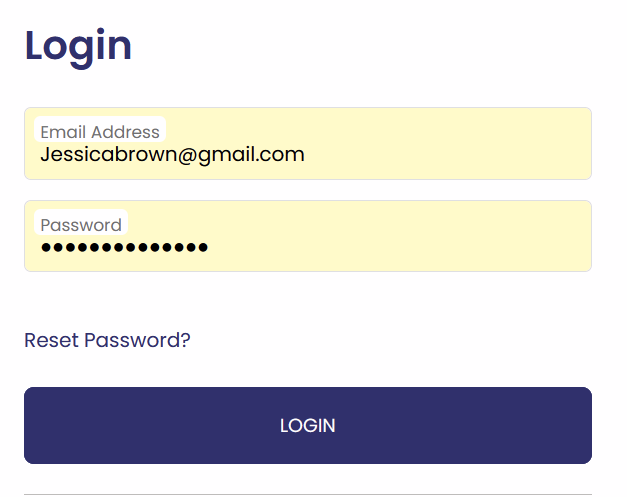
Step 2: Add New Business (For New Users)
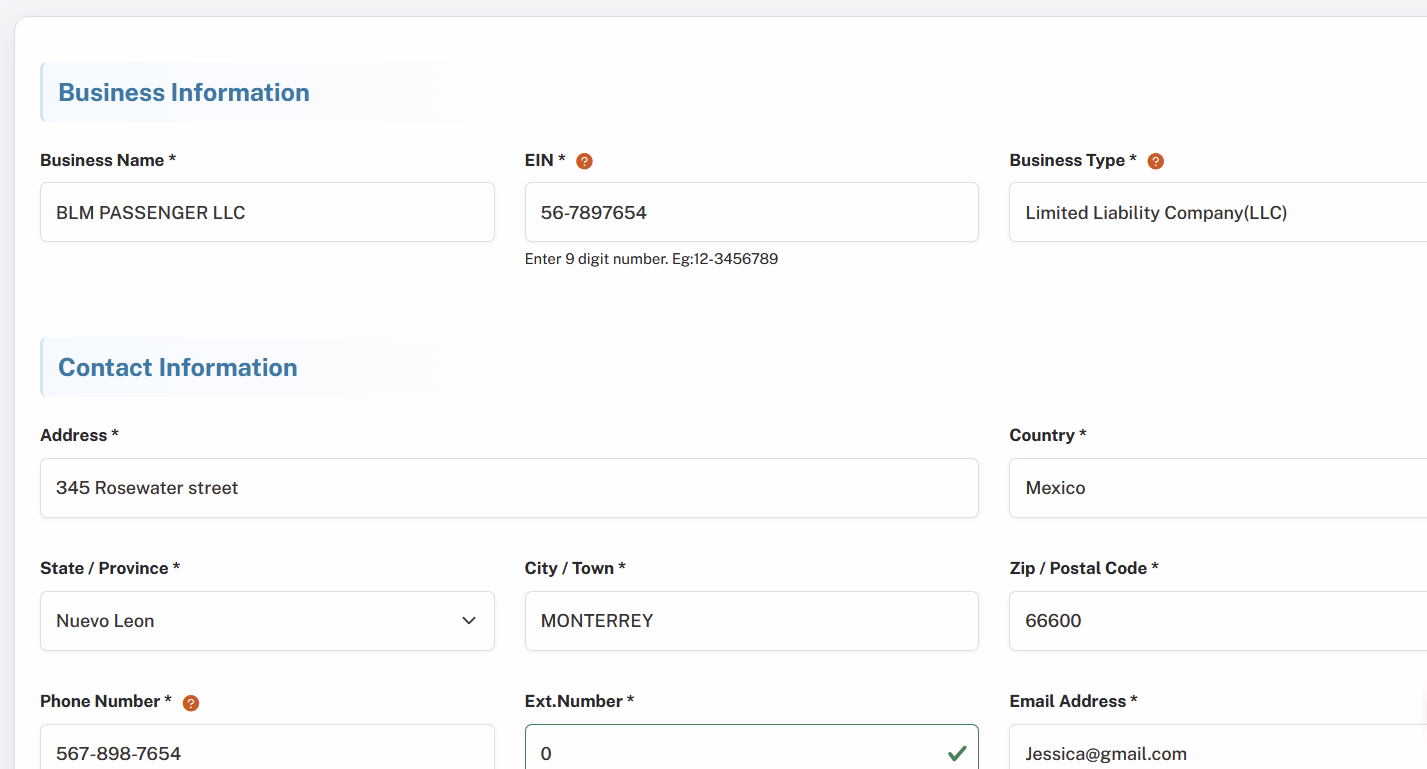
Click on Add New Business and enter your business details:
- Business Name
- Employer Identification Number (EIN)
- Business Type
- Address (with Zip Code) and Phone Number
- Signing Authority Information (Name, Title, Country, and Phone Number)
Your business information will be securely stored in our database for future filings.
- Existing Users: Select your pre-registered business from the dropdown list.
Step 3: Select Form Type
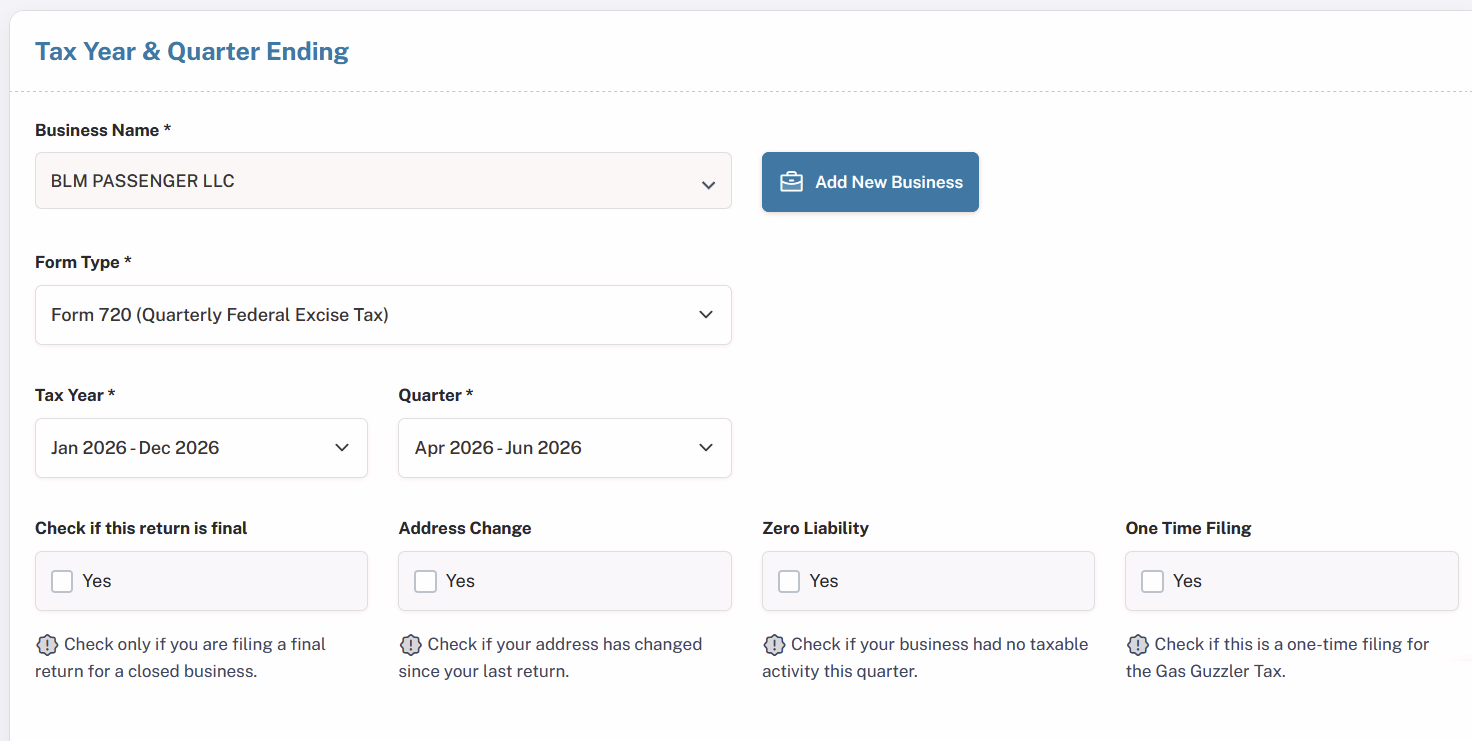
- From the dropdown menu, choose Form 720.
- Enter the Tax Year and select the correct quarter for your filing.
Step 4: Choose Filing Options
Select any applicable options, such as:
- Final Return
- Address Change
- Zero Liability
- One-Time Filing
Choose the options that best apply to your situation, and proceed to the next step.
Step 5: Select Ship Passenger Excise Tax Category
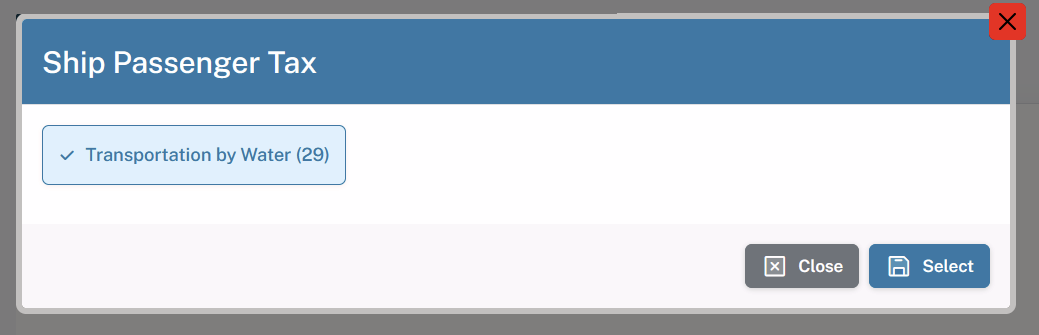
- The categories, along with their respective IRS numbers, have been listed clearly. You can now make your selection accordingly.
- In order to file a Ship Passenger tax return, please select "Transportation by Water(29)" from the Ship passenger categories in part 1.
Step 6: Provide Tax Details
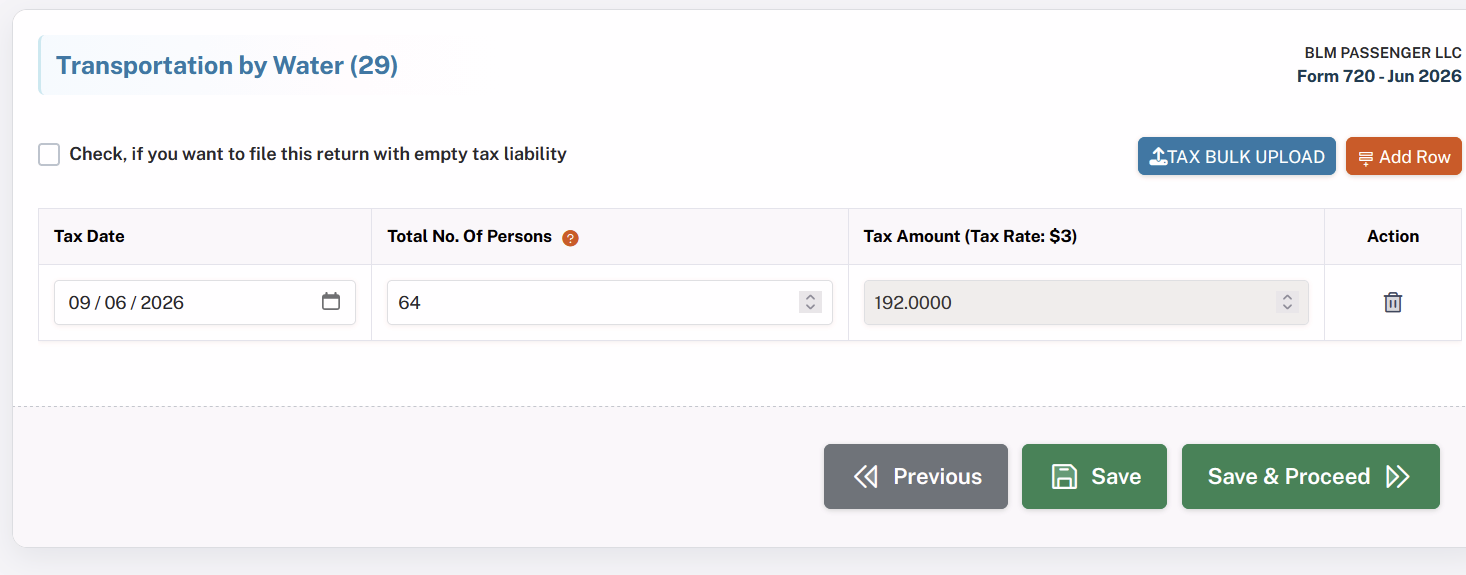
The Information to be provided will largely be determined by the type of tax that will be selected by the taxpayer. In case of ship passenger tax, you need to provide Tax date, No. of persons.
It is worth noting that the computation of the tax will be made from the above information.
Step 7: Tax Calculation
- According to Tax Rate: $3, our system will calculate the excise tax for you automatically. Please check the amount of excise tax that has been calculated.
Step 8: Claim Refunds (If Applicable)
- If you're eligible for any refunds, you will have the option to claim your refund at this stage.
- If you are not eligible for a refund, simply skip this step and proceed to payment.
Step 9: Calculate Deposits or Overpayments for Payment Adjustment (If Applicable)
In this regard, you will make up your mind about the amount that has been deposited or paid by mistake. In case you have one, then you will use this information for determining your payments. In the event that there is nothing to correct, go ahead to the next step.
Step 10: Payment Options
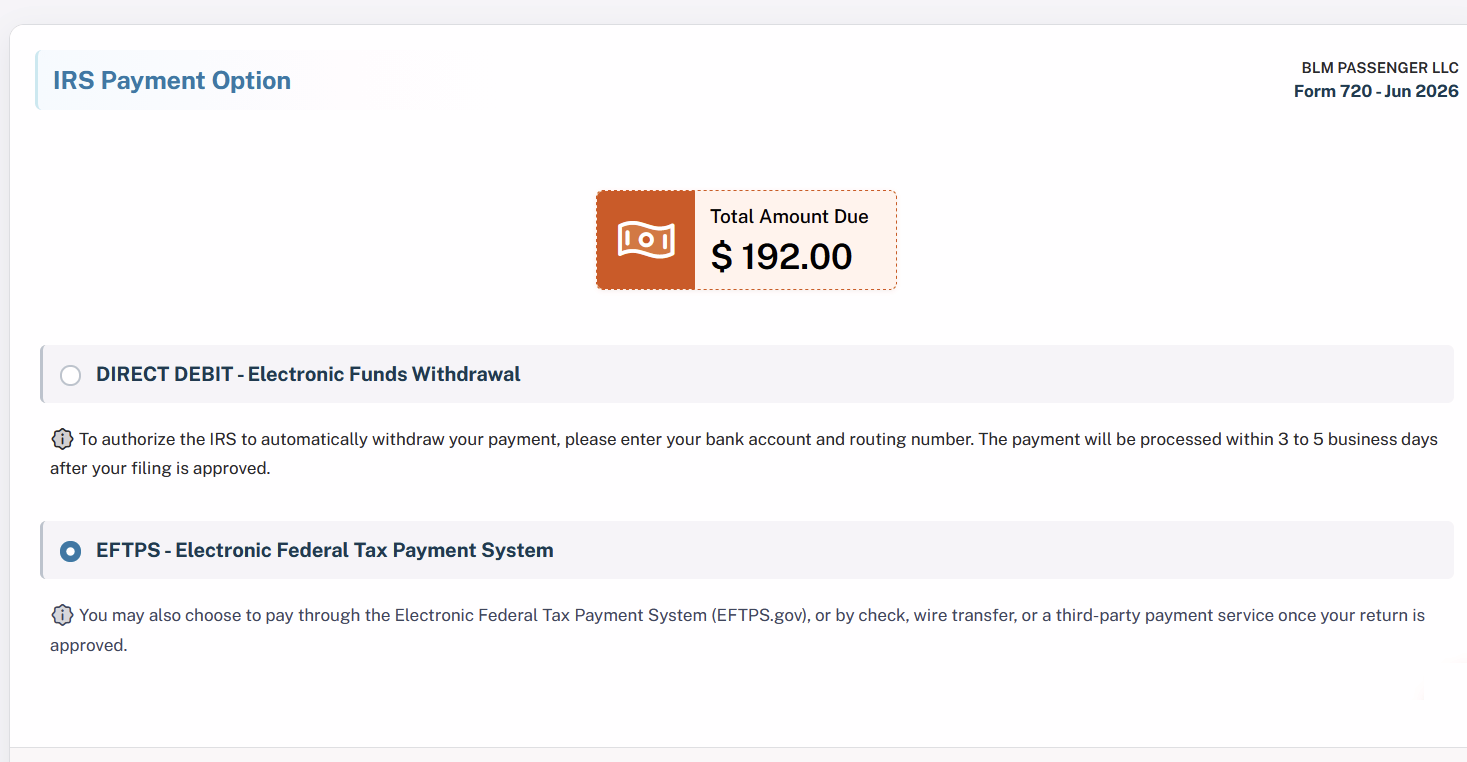
Choose one of the following secure payment methods to complete your filing:
- DIRECT DEBIT (Electronic Funds Withdrawal)
- EFTPS (Electronic Federal Tax Payment System)
Step 11: Final Summary
Review the final summary of your filing, which will include:
- All options selected
- The tax amount calculated
Once you’ve verified the details, proceed to complete your payment.
Step 12: IRS Submission and Instant Acknowledgement
Ship Passenger excise tax return is submitted to the IRS. As soon as it is approved, you will receive an acknowledgment immediately. Most probably, it will be approved within a few hours.
The whole process is sure to ensure that your ship passenger excise tax return has been filed successfully. If you need any assistance from our side, please feel free to contact us.
Why Choose QuickFile720 for your Ship Passenger Excise Tax Filing? Our Exceptional Features
IRS Authorized Portal – Rest assured because we are an IRS-authorized 720 portal for Ship Passenger Tax that complies with all the guidelines set by the IRS.
AICPA SOC 2 Certified Portal – Our AICPA SOC 2 Certified Portal will assure you that we meet all the required industry standards. As a result,we assure you of the best in terms of security, privacy, and integrity.
Form 720 Categories all under one roof – Quickfile720 has all the form 720 categories on its portal enabling you to fill your tax category within a few minutes.
Affordable Portal - QuickFile720 is the cheapest portal to file your Form 720 excise taxes in the USA. We know the hassle of the filers and hence also provide the best subscription plans.
When Is Ship Passenger Excise Tax Due? (Form 720 Deadlines)
According to the IRS, the Ship Passenger tax must be reported and paid quarterly on IRS Form 720, Quarterly Federal Excise Tax Return.
| Quarter | Tax Period Covered | Form 720 Due Date |
|---|---|---|
| Q1 | January 1 - March 31 | April 30 |
| Q2 | April 1 - June 30 | July 31 |
| Q3 | July 1 - September 30 | October 31 |
| Q4 | October 1 - December 31 | January 31 (following year) |
Important Notes:
- In case of a deadline falling on either weekend or national holiday, the deadline is automatically extended to the following business day.
- Form 720 needs to be filed on a quarterly basis, even in the case where you have liability only for one particular quarter of the year.
- Since the tax rate is $3 per person it is important for one to know about the liability and exemptions.
Such a schedule will ensure that companies follow the IRS requirements for quarterly filing of taxes for the Ship Passenger Excise tax.
What are the Ship Passenger Excise Tax Penalties (IRS Rules)
The penalties levied against the Ship Passenger tax are similar to the penalty levied against Form 720 because it is filed through Form 720.
| Penalty Type | Description | Penalty Amount |
|---|---|---|
| Late Filing Penalty | If Form 720 is filed after the due date and there is unpaid tax. | 5% of the unpaid tax per month (or part of a month), up to 25% of the total unpaid tax. |
| Late Payment Penalty | If the excise tax due is not paid by the filing deadline. | 0.5% of the unpaid tax per month, up to 25% of the unpaid tax. |
| Interest on Unpaid Taxes | Interest is charged on unpaid taxes and penalties until the balance is fully paid. | Interest accrues from the due date of the return until payment is made. |
| Failure to Deposit Penalty | If required excise tax deposits (such as semimonthly deposits) are not made correctly. | The penalty amount varies depending on how late the deposit is made. |
Important Notes
- It is possible for the two penalties to be applied together; however, the late filing penalty becomes small when two penalties are levied in the same month.
- The interest charges shall continue to accumulate until all taxes and penalties are settled.
- Big taxpayers paying excise tax are supposed to make payments too in order not to be penalized.
How to Avoid Ship Passenger Excise Tax – Form 720 Penalties
To prevent penalties and additional charges for the Ship Passenger Excise Tax, follow these essential steps:
- File Within the Deadline - Make sure that you file the Form 720 on time in order to avoid any penalty for filing the Form late.
- Make the Full Payment - You need to make the full payment through tax in order to avoid any penalty.
Key Points to Remember for Ship Passenger Excise Tax:
- Tax Rate - $3 per passenger for each taxable voyage. The tax is imposed only once per passenger for the voyage, generally at the first embarkation or disembarkation in the United States.
- Reported On - Form 720 – Quarterly Federal Excise Tax Return.
- IRS Number - IRS No. 29 – Transportation by water / Ship Passenger Tax.
- Responsible Party - The person providing the voyage, generally the vessel operator, is liable for the tax.
- Tax Code - The tax is imposed under Internal Revenue Code Sections 4471 and 4472, which govern the ship passenger excise tax and related definitions.
- Taxable Voyages Include - Commercial passenger vessel voyages extending for more than 24 hours where the vessel has berth or stateroom accommodations for more than 16 passengers, and certain commercial voyages carrying passengers engaged in gambling beyond U.S. territorial waters.
Note: A passenger generally means an individual carried on the vessel other than the master, crew members, or persons engaged in the business of the vessel or its owners.


