
What Is a Health Reimbursement Arrangement (HRA)?
- An HRA is an employer-funded plan that pays back employees for out-of-pocket medical costs, and sometimes insurance premiums too. Plan types covered include 105-HRAs, QSEHRAs, ICHRAs, and GCHRAs.
- Every self-insured HRA owes a PCORI fee, unless it's a dental or vision-only plan that is NOT integrated with a group health plan (which are exempt as "excepted benefits"). And if you're funding the plan yourself, the filing is on you, not your carrier.
Eligibility Criteria for PCORI Fee for HRAs
Issuers of Fully Insured Health Plans
Health insurance carriers that issue fully insured group plans handle this themselves. They file and pay the fee for all covered lives under the policy.
Sponsors of Self-Insured Health Plans
When an employer funds their own group health plan, they take on the PCORI responsibility directly. That means counting covered lives correctly, filling out the form, and sending payment to the IRS on their own schedule.
Employers Sponsoring Health Reimbursement Arrangements (HRAs)
Health Reimbursement Arrangements (HRAs) are treated as applicable self-insured health plans for PCORI purposes. The employer or plan sponsor is responsible for reporting and paying the PCORI fee for the HRA coverage, and liability does not fall on third-party administrators or service providers.
Sponsors of Retiree-Only and COBRA Plans
Retiree medical coverage and COBRA continuation plans are treated the same as any other self-insured plan for PCORI purposes. Their sponsors carry the filing responsibility.
Employers with Multiple Self-Insured Arrangements (Including Level-Funded or Integrated Plans)
Employers that sponsor more than one self-insured health arrangement under the same plan sponsor and plan year may treat them as a single applicable self-insured health plan for PCORI fee purposes. Each covered life is counted only once for the plan year, even if the individual is covered under multiple arrangements.
Common Challenges in PCORI Manual Filing

Manual Data Collection for Covered Lives
Pulling enrollment numbers by hand from different systems takes time, and that's where a lot of errors creep in. One wrong count from one source and your whole calculation is off before you even start.

Complex Covered-Life Method Selection
There are three accepted methods for counting covered lives: Actual Count, Snapshot, and Form 5500, and picking the right one isn't obvious. Switch methods halfway through by accident, and your filing may not hold up.

Higher Risk of Form Entry Errors on Form 720
Form 720 covers dozens of unrelated excise taxes including environmental, fuel, manufacturers, and PCORI fees. First-time filers routinely spend more time hunting for the right PCORI line than actually filling it in.

Paper-Based Record Management
Keeping physical copies of plan documents, calculations, and payment confirmations works until it doesn't. One misplaced folder and you’re scrambling come audit time.

Payment Coordination and Proof Tracking
Mailing a check with no confirmation means waiting weeks to know it arrived. Tracking proof of payment for paper filings adds work that shouldn't exist. Use EFTPS for electronic payment, scheduling by 8 pm ET the day before the due date, or file online for instant confirmation.
Why File PCORI Fee for HRAs Online?
Faster Than Paper
PCORI Fee Electronic filings process much faster than paper ones, and IRS staffing delays on mailed returns only raise the risk of missing your deadline.
File From Any Device, Any Time
No printer, no post office, no waiting. Log in and submit from any browser, whenever it works for you.
Fewer Errors at Submission
Online platforms catch missing fields before you hit submit, so problems surface during filing rather than after the IRS receives it.
Clear Filing Records
Every electronic submission creates a dated, trackable record you can pull up if questions come up.
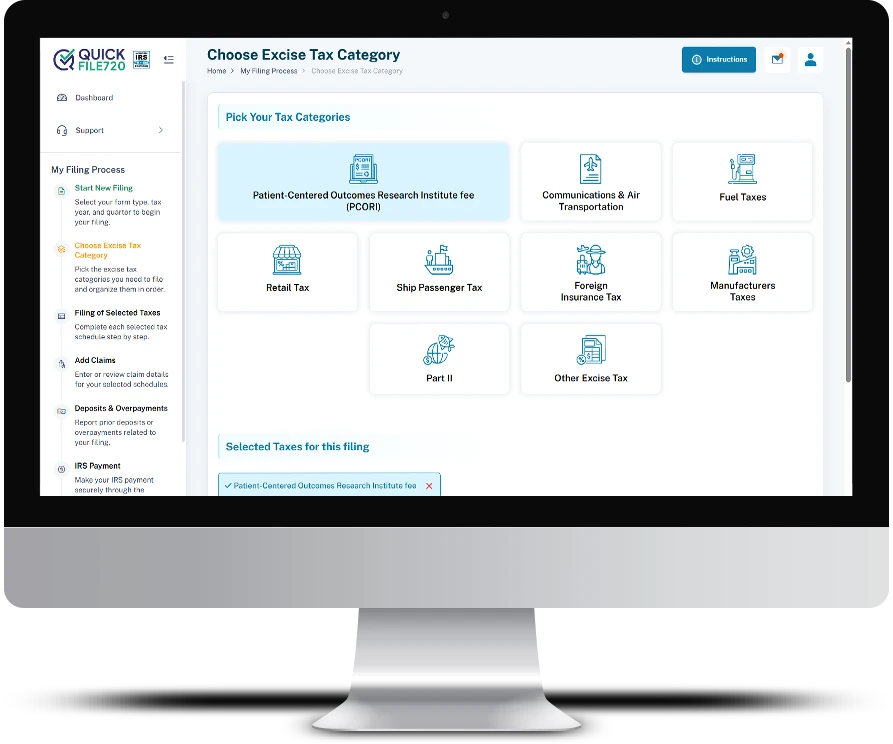
Why File PCORI Fee for HRAs With QuickFile720?
IRS-Authorized Portal
QuickFile720 holds direct IRS authorization for Form 720 e-filing, so every submission goes through a compliant, approved channel. You get real-time IRS acknowledgment instead of waiting on mail that may or may not have arrived.
IRS-Certified Security Standards
The platform runs under IRS-certified security standards, keeping your plan data and business information away from unauthorized access. That's not a small thing when you're submitting employer and employee information to the IRS.
Simple and Affordable Solution
No expensive software, no downloads, no steep learning curve to get through. The interface is built to be straightforward, and the pricing works for businesses of pretty much any size.
Excise Tax Specialists on Call
Support comes from federal excise tax experts, not a general helpdesk, so you get answers from people who actually know this space.
Testimonials
Filed before my coffee got cold
I sponsored a QSEHRA for a small team and wasn't looking forward to Form 720 again. QuickFile720 walked me through it and did the math for me. Done faster than I expected; confirmation came the same day.
No more mailing it and hoping
Used to print Form 720, drop it in the mail, and wait. Now I get confirmation the same day I file the PCORI fee for my HRA. No guessing whether it actually arrived.
Didn’t have to dig through IRS instructions
I handle PCORI filings for several client HRAs as a benefits administrator. The platform I use is updated in line with the latest IRS guidance, so the correct lines and calculations are already built in
Your PCORI Fee for HRAs Is Due July 31
File your PCORI fee for HRAs online, get confirmation the same day, skip the paperwork, and keep a digital record you can find next year.
File My PCORI Fee for HRAs Now