
QuickFile720
What is Remittance Transfer Tax?
Remittance Transfer Tax is a federal excise tax imposed under Internal Revenue Code (IRC) Section 4475, introduced by the One Big Beautiful Bill Act of 2025. Effective January 1, 2026, a 1% tax applies to certain money transfers made from the United States to recipients in foreign countries.
Who Pays Remittance Transfer Tax?
The Remittance Transfer Tax is paid by individuals who send money from the United States to recipients in foreign countries using taxable payment methods. However, remittance transfer providers are responsible for collecting and reporting the tax to the IRS.
Sender
Pays the 1% excise tax on applicable remittance transfers.
Remittance Transfer Provider
Collects the tax from the sender and deposits it with the IRS.
Filing Responsibility
Remittance transfer providers must report the collected tax quarterly using IRS Form 720.
Uncollected
Tax
If the provider fails to collect the tax from the sender, the provider becomes responsible for paying it.
Note: Transfers funded through qualifying bank account withdrawals or U.S. issued debit or credit cards are generally excluded from this tax.
Common Challenges in Filing Remittance Transfer Tax

Identifying Your Remittance Transfer Tax Obligations
Determining whether your business is required to collect and report Remittance Transfer Tax can be challenging. Misunderstanding the applicable tax rules may lead to incorrect filings or noncompliance.

Applying an Incorrect Tax Rate
Using the wrong tax rate when calculating Remittance Transfer Tax can result in underpayment or overpayment. The applicable tax rate is 1% of the taxable remittance transfer amount.

Missing Quarterly Filing Deadlines
Failing to submit Form 720 by the IRS quarterly filing deadline may result in penalties and interest. Keeping track of due dates is essential for timely tax reporting.

Overlooking Semimonthly Tax Deposits
Missing required semimonthly excise tax deposits can lead to IRS penalties, even if Form 720 is filed on time. Businesses must monitor their deposit obligations and follow the applicable IRS deposit schedule.

Errors in Calculating Remittance Transfer Tax
Incorrectly identifying taxable transactions or calculating the tax amount can lead to inaccurate reporting. Maintaining accurate transaction records helps ensure proper tax calculations and compliance.
Smart Solutions for Remittance Transfer Excise Tax Filings - QuickFile720
Correct Application of IRS Tax Rates
QuickFile720 applies the IRS-prescribed 1% Remittance Transfer Excise Tax rate to your reported taxable amount, helping you avoid errors caused by incorrect tax rates.
Accurate and Automated Tax Calculations
Eliminate manual calculation errors with our automated tax calculation feature. QuickFile720 calculates your tax liability based on the taxable remittance amounts you enter.
Simple and Quick Online Filing Process
Complete your Remittance Transfer Excise Tax filing in just a few easy steps. Our user-friendly platform simplifies Form 720 preparation and submission, saving you valuable time.
Secure and Reliable IRS-Authorized E-Filing
File your Form 720 confidently through our secure, IRS-authorized e-filing platform. QuickFile720 helps protect your sensitive tax information throughout the filing process.
Easy Filing Status Tracking and Confirmation
Stay informed about your Form 720 submission with convenient filing status updates. Track your return's progress and access IRS acceptance confirmation once your filing is approved.
Remittance Excise Tax Filing: Manual vs Online Steps

- 1. Download the latest version of Form 720 from the official IRS website.
- 2. Enter business details including name, address, EIN, and contact information
- 3. Enter the correct tax quarter and tax year manually.
- 4. Review Form 720 instructions to locate Remittance Transfer Excise Taxes(155) under Part 1 - Other excise tax
- 5. Enter the amount of transfer made
- 6. Manually calculate 1% tax on the amount.
- 7. Enter the calculated tax amount on the correct line under IRS number 155
- 8. Double-check calculations and line entries for accuracy.
- 9. Prepare payment by check or money order payable to the United States Treasury and complete Form 720-V payment voucher
- 10. Mail the completed Form 720 and payment to the appropriate IRS address.

- 1. Create your free QuickFile720 account and log in securely.
- 2. Enter your business information including name, address, EIN, and filing quarter.
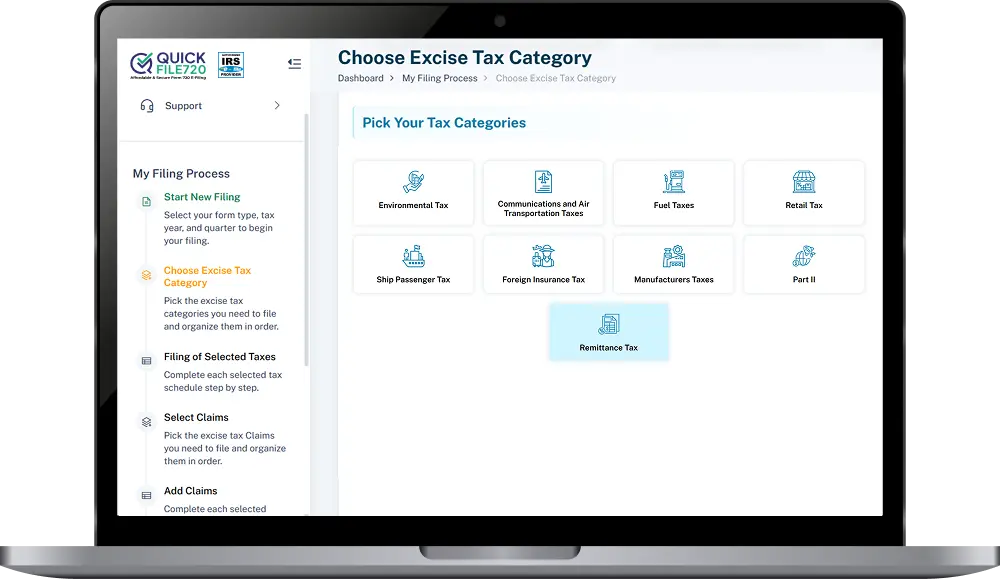
- 3. Select “Remittance Transfer Tax(155)” under the Other Excise Tax category
- 4. Provide the Tax date and Principal amount
- 5. Your tax amount is automatically calculated and displayed for review.
- 6. Submit your return online with secure payment and receive Instant Acknowledgement
Frequently Asked Questions
Testimonials
Affordable Pricing with No Hidden Fees
QuickFile720 made filing our Remittance Transfer Tax simple and budget-friendly. The affordable pricing and transparent fees made it a great choice for our business.
Quick and Hassle-Free Filing Experience
Filing Remittance Transfer Tax was easier than expected with QuickFile720. The straightforward steps and user-friendly platform helped us complete our Form 720 filing without complications.
Fast Filing with Instant Acknowledgement
QuickFile720 made submitting our Remittance Transfer Tax return fast and convenient. We received an immediate submission acknowledgement and could easily track our IRS filing status.
Key Details to Remember
| Governing Section | IRC Section 4475 |
| Tax Rate | 1% of the taxable remittance transfer amount |
| Effective Date | January 1, 2026 |
| Applicable Payments | Cash, money orders, cashier's checks, and similar physical instruments |
| IRS Tax Code | 155 |
| Filing Form | IRS Form 720, Quarterly Federal Excise Tax Return |
Filing the Remittance Transfer Tax is now
becoming too complicated for you?
Learn here how QuickFile720 can help make filing Form 720 easy through our online, convenient, and secure solution. Get our excise tax specialists to guide you on your filing needs, from computation to filing your returns.
Book your free demo now and experience a better and more cost-effective way of handling your Remittance Transfer Tax returns.
Book Your Free Demo